
✕
Unclear Tag Ownership & Legacy Tags
Years of agencies and experiments have left many GTM containers full of legacy tags, unclear naming conventions, and zero ownership.
Tracking · GTM Audit
Our comprehensive Google Tag Manager audit cuts through years of quick fixes, agency leftovers, and experiments. We transform your container into a clean, documented, high-performance measurement layer — turning it into an asset instead of a liability.
Built for growth and product teams who can't afford a fragile or unreliable tracking setup.
Why GTM feels fragile
Google Tag Manager is incredibly powerful — but only if you treat it like production code, not a sandbox. Our GTM audit turns your container into something you're comfortable scaling on.
Years of agencies and experiments have left many GTM containers full of legacy tags, unclear naming conventions, and zero ownership.
Multiple pixels firing on every page, synchronous scripts, and sloppy triggers quietly chip away at page speed and Core Web Vitals.
Two "purchase" tags here, no event there, custom scripts that fire on the wrong pages — leading to unreliable data.
Unreviewed third-party scripts and unclear consent behavior can become a legal and reputational liability.
What the GTM audit covers
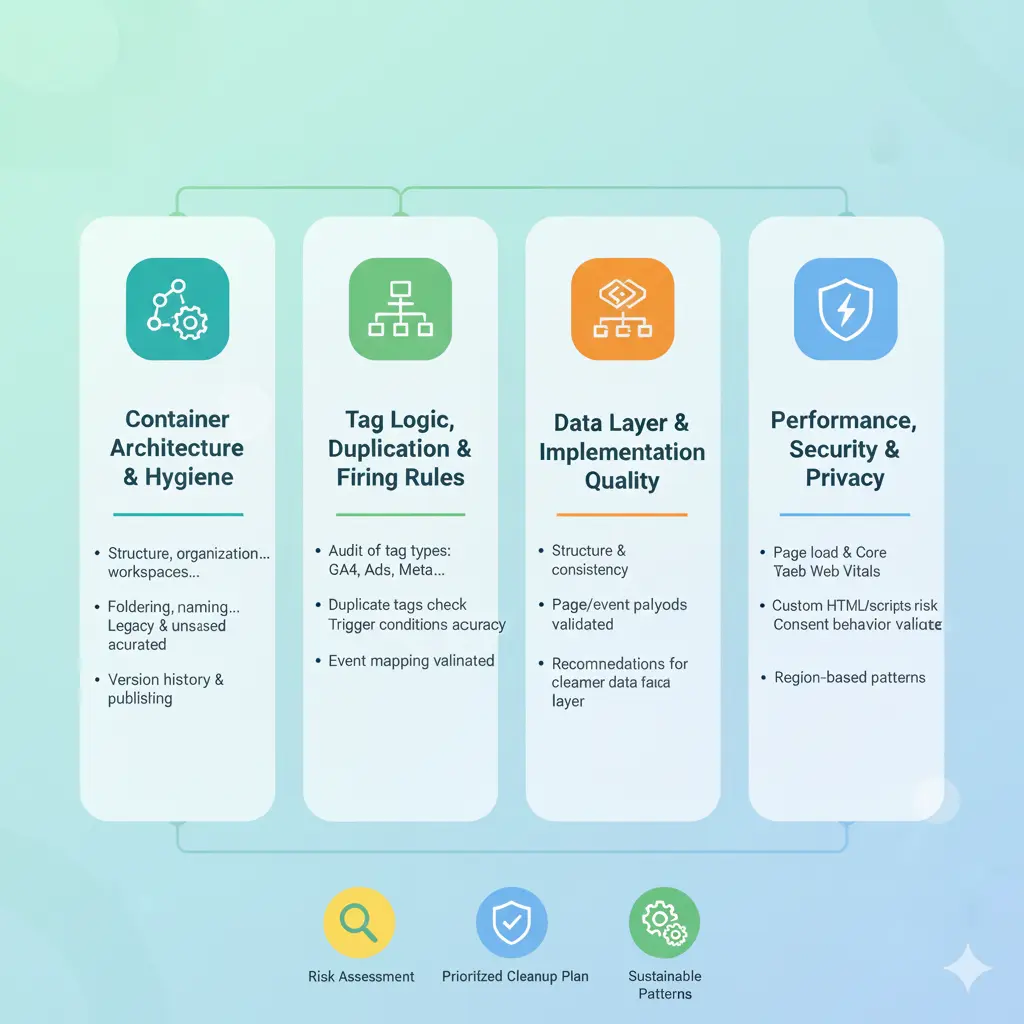
We don't just hand you a list of broken tags. Our Google Tag Manager audit provides a clear picture of risk, a prioritized cleanup plan, and sustainable patterns to keep your GTM stable.
Reviewing the structure, organization, and understandability.
Deep dive into where data quality succeeds or fails.
Verifying that GTM captures the data you need.
Addressing aspects often overlooked until issues arise.
10-Day GTM Forensic Audit
We treat your GTM container like production infrastructure. Every recommendation from our Google Tag Manager audit is meticulously documented and fully testable.
Secure access, export containers, and create safe rollback points. Map the current state of your GTM setup.
Assess foldering, naming conventions, and environments. Flag clutter and dangerous patterns within your container.
Deep dive into triggers and duplicates. Match firing rules to actual user journeys and business objectives.
Inspect data layer payloads and variables. Validate critical events like leads and purchases for accuracy.
Analyze load time impact, identify risky scripts, and review consent mode behavior for compliance.
Delivery of a comprehensive audit deck, risk ranking, and a prioritized cleanup plan for your GTM container.
We provide a draft of findings before the final deck to align on risk priorities and ensure full transparency.
Proof It Works
After our intervention, your Google Tag Manager container stops being a black box and becomes something your team understands, trusts, and can keep healthy.
Fillip Fleet
Removed unused tags, consolidated events, and tightened triggers — resulting in a 45% reduction in GTM tag count while significantly improving revenue accuracy.
Read case study →
Government of Canada
Re-architected containers around a shared measurement schema, introduced environments, and added guardrails to standardize GTM without breaking existing flows.
Read case study →
NextCare
Reviewed all scripts, restricted risky tags, and aligned firing with CMP guidance to bring GTM in line with consent and HIPAA requirements without losing critical data.
Read case study →
A GTM audit is a comprehensive review of your Google Tag Manager container to identify issues like duplicate tags, incorrect firing rules, performance bottlenecks, and data layer inconsistencies. You need one to ensure accurate data collection, improve site performance, maintain privacy compliance, and prevent tracking errors.
Our forensic GTM audit is designed to be thorough yet efficient, typically completed within 10 business days. This includes initial access, detailed review, analysis, and delivery of a comprehensive report with actionable recommendations.
Yes, absolutely. A key part of our GTM audit focuses on identifying and rectifying issues that negatively impact page load times and Core Web Vitals, such as inefficient tag firing, synchronous scripts, and excessive tag counts. Optimizing these can lead to significant performance improvements.
You will receive a detailed audit deck that includes a clear picture of identified risks, a prioritized cleanup plan, and specific recommendations for improving your GTM container's architecture, tag logic, data layer, performance, and privacy compliance.
Yes. While the audit itself is a diagnostic deliverable, most clients retain us to implement the cleanup. We can work in your workspace, creating a 'Cleanup' version that you can review and publish after testing.