

In the last six months, the marketing world has reached a tipping point. With the full-scale rollout of Meta’s MCP and Google’s MCP, the "how" of media buying has officially been solved.
We’ve moved past simple automation into the era of Agentic AI. Today, your campaigns aren't just adjusting bids; they are querying their own performance, rewriting creative hooks in real-time, and reallocating budgets across channels based on predictive LTV.
But as we sit here in May 2026, a strange paradox has emerged at the enterprise level:
Companies are spending more than ever on AI-driven media tools, yet the efficiency of those tools is hit-or-miss.
If the AI is the most sophisticated it’s ever been, why are so many enterprise accounts stagnating?
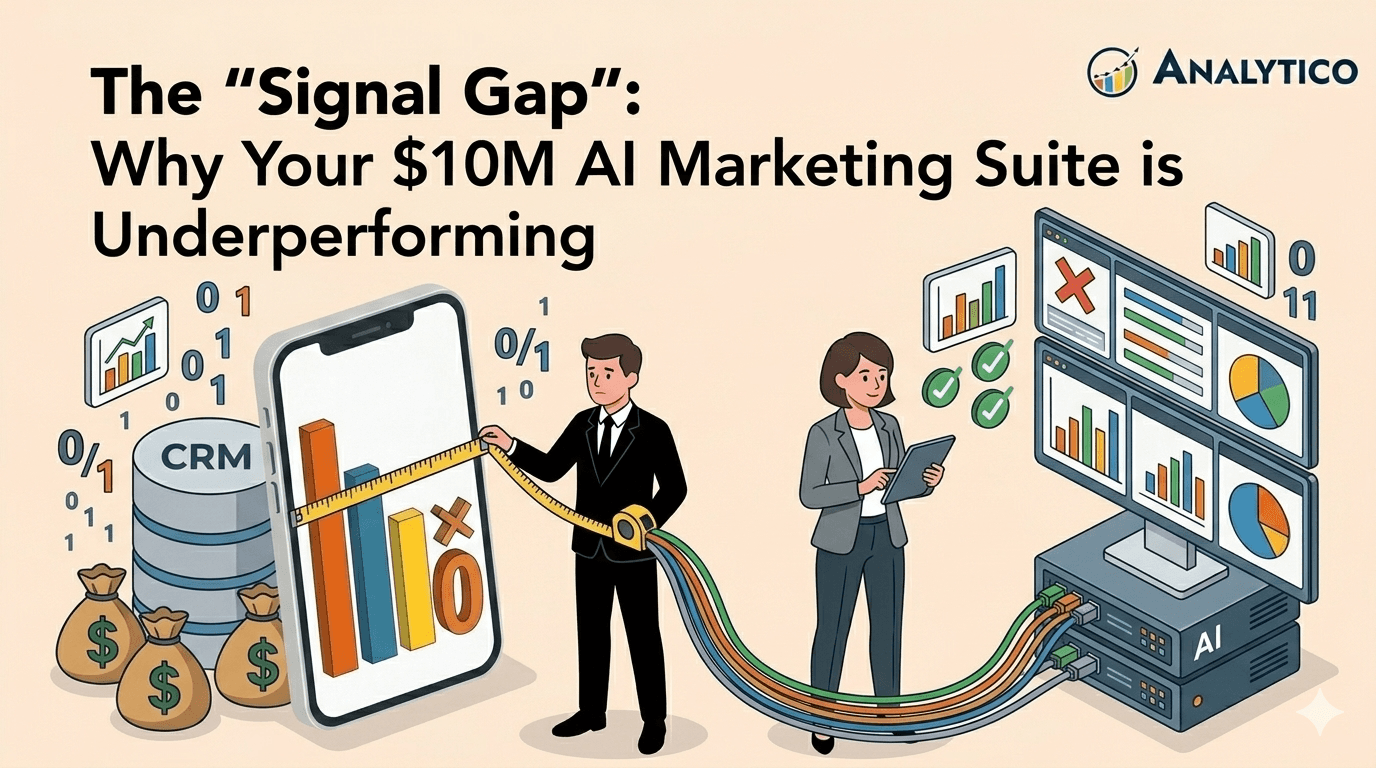
At Analytico, we’ve identified the culprit. It’s not the AI. It’s the Signal Gap.
The Formula 1 Paradox
Imagine you’ve just purchased a multi-million dollar Formula 1 car. It’s a masterpiece of engineering. You hire a world-class driver—your media agency—to take the wheel.
But there’s a problem. You’re asking them to race on a dirt track full of potholes.
No matter how good the car is, and no matter how skilled the driver is, the car cannot perform. The "road" is the data foundation. And in 2026, most enterprise "roads" are still under construction.
What is the "Signal Gap"?
The AI systems inside Google and Meta (the Control Planes) operate on a simple feedback loop: Signal in, Optimization out.
But for a mid-to-large enterprise, that "Signal In" part is incredibly complex. Unlike a small Shopify store where a pixel does 90% of the work, an enterprise has:
- Delayed CRM data: Sales cycles that take 3–6 months.
- Offline Conversions: High-value deals closed over the phone or in-person.
- Identity Resolution: Customers moving between five different devices and three different email addresses before buying.
- Privacy-First "Noise": Modeled data filling the gaps left by cookie-less browsing.
When these signals are messy, the AI doesn't stop. It just gets "confused." It begins optimizing for Proxies (like clicks or "soft" leads) instead of Profit. The result? You pay what we call a "Signal Tax"—a 20% to 30% inefficiency in your ad spend caused by the AI chasing the wrong version of reality.
Why Your Media Agency Isn’t a Measurement Architect
This is the part that many VPs of Marketing find uncomfortable to hear: Your media agency is likely not equipped to fix this.
This isn't a knock on media agencies. Their job is to be the "Drivers." They are experts at creative strategy, platform nuances, and competitive positioning.
But Measurement Architecture is a distinct engineering discipline.
- A Media Agency asks: "How do we get more people to click this ad?"
- A Measurement Architect (Analytico) asks: "How do we ensure that when a $50k deal closes in your CRM, the Meta MCP receives that signal within 60 seconds, perfectly attributed to the correct session, so the AI knows exactly where to find ten more people just like that buyer?"
One is about execution; the other is about infrastructure.
The 2026 Reality: Signal > Strategy
In the 2024 era, a "clever" bidding strategy could save a campaign. In 2026, the bidding strategy is the AI. You can't out-think the Google Control Plane.
The only lever left for humans to pull—the only real competitive advantage—is the quality and speed of the signals you feed the machine.
According to recent industry benchmarks, advertisers who provide 1st-party, real-time verified signals see up to a 2X higher ROAS compared to those relying on standard platform tracking. That isn't because their creative is twice as good; it's because their AI is twice as "smart" because it's better fed.
Closing the Gap
If you are an enterprise leader looking at your 2026 performance, ask yourself:
- Is our CRM data piped back into our ad platforms in real-time, or is there a "data lag"?
- Are we optimizing for "Lead Gen" (easy for AI) or "Qualified Pipeline" (hard for AI without custom architecture)?
- Do we have a dedicated team building our Signal Road, or are we just hoping our "Drivers" can handle the potholes?
The era of manual media buying is over. The era of the Measurement Architect has begun.
Don’t blame the AI. Fix the fuel.
At Analytico, we specialize in building the high-performance data architecture that makes enterprise AI marketing actually work. If you're ready to stop paying the 'Signal Tax,' let’s talk.